
Were Overseas Views Really Zero? Checking the Answers in the YouTube Analytics API
After localizing our video channel into dozens of languages without reaching overseas viewers, I connected the YouTube Analytics API to measure the actual numbers. Even after trying new changes, the reports still showed "zero overseas views"—until a closer look revealed that views from individual countries were simply too small to pass the API's reporting threshold. Here is how I realized we were misreading the numbers.

In “Zero Views Across 56 Languages, but 1,000+ Views on the Very First Short,” I wrote about how translating our video descriptions into 56 languages brought almost no overseas views, leading us to scale back to 14 languages in June.
When I decided to cut back the number of languages in June, I was looking at the YouTube Studio dashboard with a vague sense that nobody overseas was watching. Several months passed without my being able to pin down why we weren’t reaching anyone outside Japan, or what was actually happening in the data.
It was in mid-August that I connected the YouTube Analytics API to pull detailed viewing data and began investigating in earnest. This article is a record of checking our assumptions against the numbers once we could finally measure the facts.
Adding One Scope Took Two Minutes
What prompted me to dig deeper was a long-form video by an independent creator. It was an unhurried video capturing an ordinary evening in a Japanese home, yet the comment section was filled with comments in English from overseas viewers, and the video had passed a million views.
Our channel, “Sounds of Rain in Old Japan,” had been translating titles and descriptions into dozens of languages with that exact overseas audience in mind. Yet in reality, we were barely reaching anyone outside Japan.
I wrote to the AI agent I use in my daily development work to talk it through:
For “Sounds of Rain in Old Japan,” we have been translating descriptions and titles into multiple languages aiming for overseas viewers, but we aren’t reaching them at all.
I also mentioned that when a summer intern visiting from an American university tried searching for our channel, nothing came up unless the exact channel name was typed in full. Then I added:
Maybe there is a hint in how that creator sets up their videos, or maybe the conclusion will simply be that they already have a large subscriber base and high view counts.
During that conversation, every time I asked about traffic sources or where our Shorts views were coming from, the agent answered: “That cannot be measured.” The saved authentication token did not have the read-only permission for analytics (yt-analytics.readonly) attached.
Adding the scope itself took about two minutes. I wished I had realized much earlier that simply adding analytics read permission would create this kind of feedback loop with the agent.
The First Numbers We Measured
When I pulled the regional breakdown of views from the channel’s launch through mid-August, the results looked like this:
Japan         15,118 views  (99.8%)
South Korea       23 views   (0.2%)
(All other countries: zero)
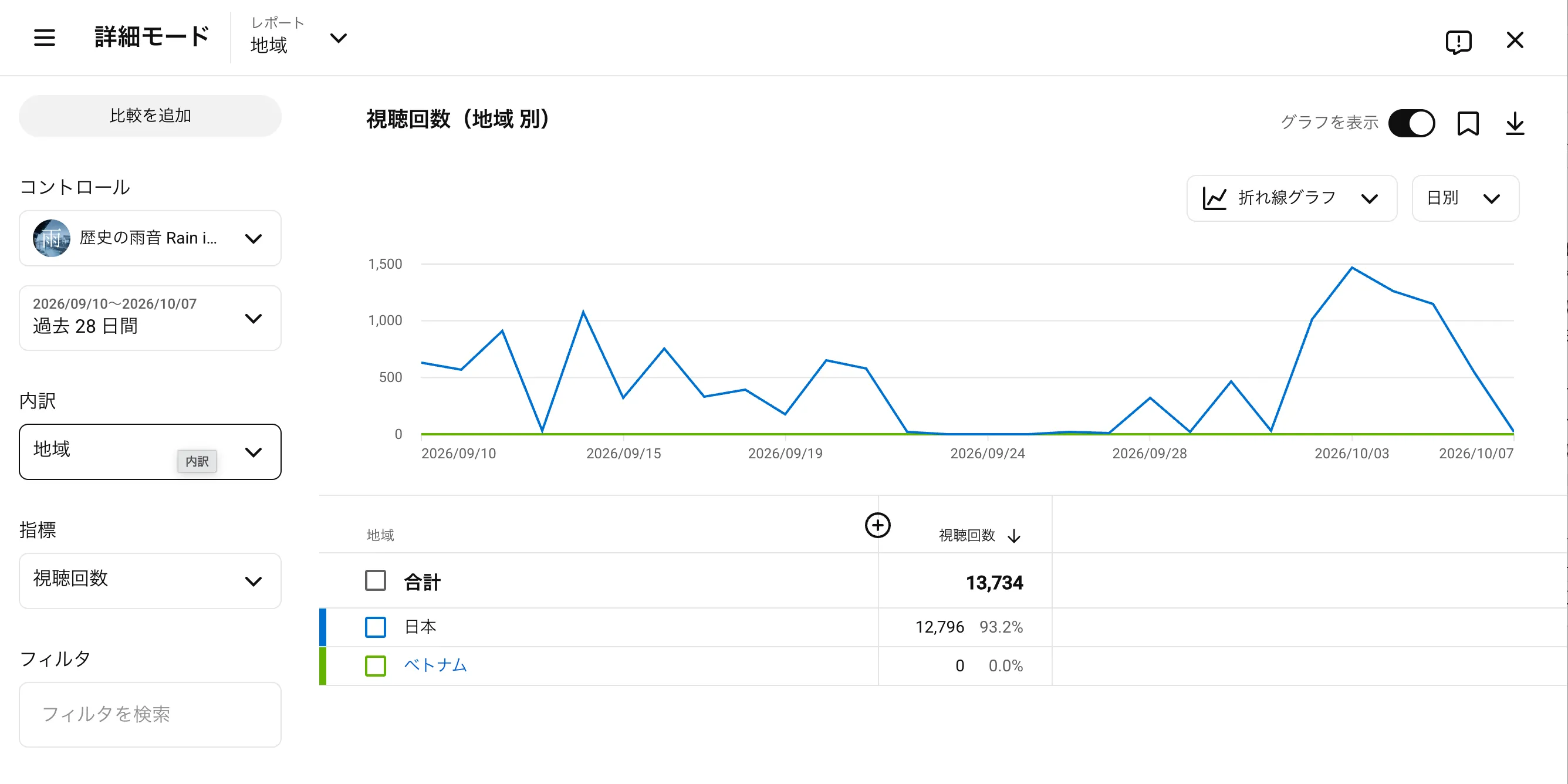
Across five months of operation, there were only 23 views outside Japan, and every single one of them was from South Korea.
When I checked the million-view video that had caught my attention earlier, it had only a Japanese title and subtitles in six languages. Meanwhile, our long-form videos had localized titles configured in 51 languages, yet their view counts remained in the low hundreds.
That comparison alone made it clear that the sheer number of translated languages does not determine whether a video reaches an overseas audience. That creator’s video conveyed spoken dialogue carefully through subtitles, which appeared to give YouTube’s algorithm strong cues for understanding the video’s context. For our videos, which consist only of ambient rain sounds without a single spoken word, that approach could not be applied directly.
Looking at Views and Watch Time Side by Side
Pulling the raw data also revealed something else I had overlooked.
Until then, I had assumed that Shorts—which regularly drew thousands of views—were the pillar of the channel, and the agent had likewise reported that roughly 90% of all views came from Shorts.
However, once the YouTube Analytics API was connected, it became easy to line up not only view counts, but also total watch time and average view duration side by side.
| Content | Views | Total Watch Time | Average View Duration |
|---|---|---|---|
| Shorts | 13,560 (85%) | 25 hours (13%) | ~6 sec |
| Long-form videos | 2,428 (15%) | 167 hours (87%) | ~4 min |
Long-form videos accounted for only 15% of total views, yet they made up 87% of the channel’s total watch time. Focusing only on the more visible view counts had caused me to overlook how much time viewers were actually spending with each format.
Trying Three Changes
After looking at the numbers in mid-August, I tried three changes at the same time.
First, I changed the default base title on all 29 long-form videos to English. Since English titles already existed for every scene as a leftover from our 56-language translation workflow, this required no extra cost. I moved the Japanese titles into the localized Japanese slot, so nothing changed for viewers in Japan. When I checked YouTube search results for terms like “Edo period rain sounds” in English, the top results were all channels that used English as their default title—even channels with only a few dozen subscribers.
Second, in the descriptions of our high-performing Shorts, I added direct links to the long-form videos depicting the same historical scenes.
Third, to build an external discovery path, I started automatically cross-posting our Shorts to Instagram Reels (the setup walkthrough is here).
Two Weeks Later
When I checked the analytics two weeks later on August 27, the results were sobering.
| Change | Result After Two Weeks |
|---|---|
| English base titles on 29 long-form videos | Views from YouTube search dropped in half, from 15 to 7. Overseas views: zero |
| Link referrals from Shorts | Out of 3,794 views, only 4 link clicks (roughly 0.1% click-through rate) |
| Cross-posting to Instagram Reels | Reached 2,681 accounts, but zero people clicked the YouTube link in our bio |
On paper, none of the three changes appeared to have produced any meaningful effect.
During those same two weeks, I had not published a single new long-form video. The first thing I wrote to the agent that day was:
A bit of time has passed—I uploaded quite a few Shorts, but I haven’t made any long-form videos. I slacked off on those.
Yet the watch time on our existing 29 long-form videos had grown from 3 hours in the preceding two-week period to 14 hours. The increase came from suggested videos; tracing the source showed our videos appearing alongside Japanese sleep BGM and ambient sound videos. They were not viewers brought in by the English titles. And because I had changed three things at once, there was no way to isolate which change, if any, had contributed.
Suggested videos are determined by what the same viewers watch together. Our long-form videos appeared next to Japanese ambient videos because our existing viewers were people in Japan who watched Japanese ambient videos; to appear next to English-language videos, viewers in English-speaking regions would need to watch ours first. At the time, I thought this feedback loop was the reason we could not break out overseas.
Misreading “Zero”
About a week later, I asked the agent to run the analysis once more:
I still haven’t published any new long-form videos as of today, but please analyze the analytics again. I have a feeling some overseas views are starting to mix into the long-form videos.
The agent’s initial conclusion was the exact opposite: “Across the entire history of the long-form videos, there is not a single view identified as coming from outside Japan.” Even in the three weeks after switching the base titles to English, long-form videos had 155 views, and of the 27 views where a country was identified, all 27 were from Japan.
What kept the agent from stopping there was noticing how low the country identification rate was: just 17%. Back on August 27, the number of views identified as Japan had also been 27, yet total views had grown by 30—from 125 to 155. Not a single one of those 30 new views had a country attached to it.
Digging into the documentation led us to a specific behavior of the YouTube Analytics API.
For privacy and thresholding reasons, when views from a given country or region are very small, YouTube Analytics does not group them into an “Other” row—it omits those country rows from the response entirely. At a small scale of a dozen or so views per week, individual countries fall below the threshold and are dropped row by row, leaving no trace in the report.
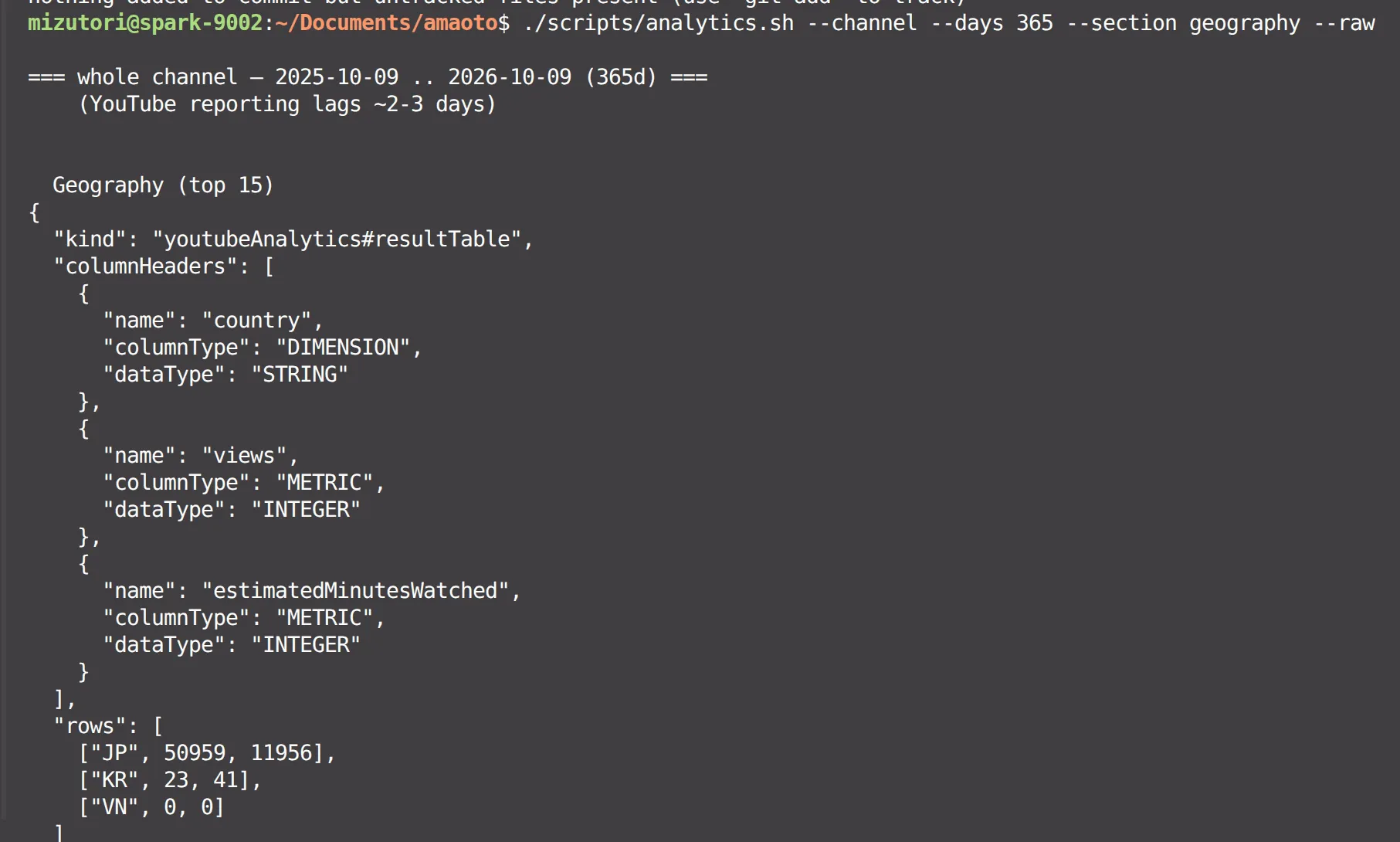
Even so, that alone left open the possibility that the views were simply too small in total to pass the threshold, and that in reality all of them still came from Japan.
To test that, we lined up Shorts and long-form videos with similar total view counts and compared the percentage of views for which a country was identified.
| Video Type | Total Views | Views Identified as Japan | Identified Share |
|---|---|---|---|
| Short A | 118 | 79 | 67% |
| Short B | 168 | 128 | 76% |
| Short C | 276 | 267 | 97% |
| Long-form (Edo Tenement Row) | 110 | 27 | 25% |
If the reporting threshold worked the same way across videos, Shorts and long-form videos with comparable view counts should not have shown such a wide gap in their identified shares.
If those unidentified views had come from Japan, they would have been added to the “Japan” row, which had already cleared the threshold. The fact that the identified share dropped to 25% only on the long-form video meant the remaining 75% of views were scattered across countries outside Japan, with no single country reaching the reporting threshold on its own.
In fact, looking across the entire catalog, Japan accounted for only 47% of the 1,989 long-form views, whereas nearly all of the 15,209 Shorts views came from Japan. And the two comments left on our long-form videos in the early days of the channel had both been written in Korean.
The agent’s earlier report that “not a single view was identified outside Japan” was accurate as a description of the returned API rows, but wrong as a conclusion. By conflating “no data was returned” with “no views occurred,” we had jumped all the way to concluding that the English titles were not working.
Changing How We Measure the Unmeasurable
When we measured again on September 17, the contrast had become even clearer. Out of 83 long-form views over the preceding two weeks, 0 had an identified country, while 92% of Shorts views during the same period were identified as Japan. Overseas viewers were finding only the long-form videos, while Shorts remained almost entirely within Japan.
At our current scale, we cannot directly measure the exact number of overseas views. Instead, we decided to track how low the Japan-identified share is as a proxy indicator. With Shorts at 92–95% and long-form videos at 0–45%, a widening gap tells us that overseas viewing is growing. Once an individual country eventually crosses the reporting threshold and appears as its own row, we will be able to make firmer decisions on direction.
What Measuring Taught Me
Looking back, the hypotheses that both the agent and I came up with before connecting the API were either off the mark or impossible to verify. Given that adding the read permission took only two minutes, I should have started measuring much sooner.
And even after we began measuring, I misread what the numbers were saying. On a report, “zero” and “too small to be displayed” look identical. The only way to verify what was happening in the invisible numbers was to line them up alongside the visible ones and compare.
If you are working through how to design analytics measurement for your product or service, or how to interpret what your data is actually telling you, feel free to get in touch. We would be glad to help look past the surface numbers and read the structure underneath together.