
Zero Views Across 56 Languages, but 1,000+ Views on the Very First Short
I translated and published video descriptions into 56 languages for a rain sound channel. Three months later, virtually all views were from Japan, proving that discovery paths simply didn't exist and prompting a cutback to 14 languages. Meanwhile, a lightweight vertical Short cleared 1,000 views on its first run — a record of hypothesis testing on YouTube.
When I started the YouTube channel Sounds of Rain in Old Japan, I had one hypothesis. Rain needs no translation. The videos are designed with no narration and no subtitles, so if I localized just the title and the description, a single video should be able to reach viewers worldwide, as it was.
YouTube’s multilingual localization feature is free. The translation is handled automatically by an AI agent pipeline (the full overview is here), so the marginal cost is just one API call per language. If so, I thought, why not deliver to every language there was any chance of reaching?
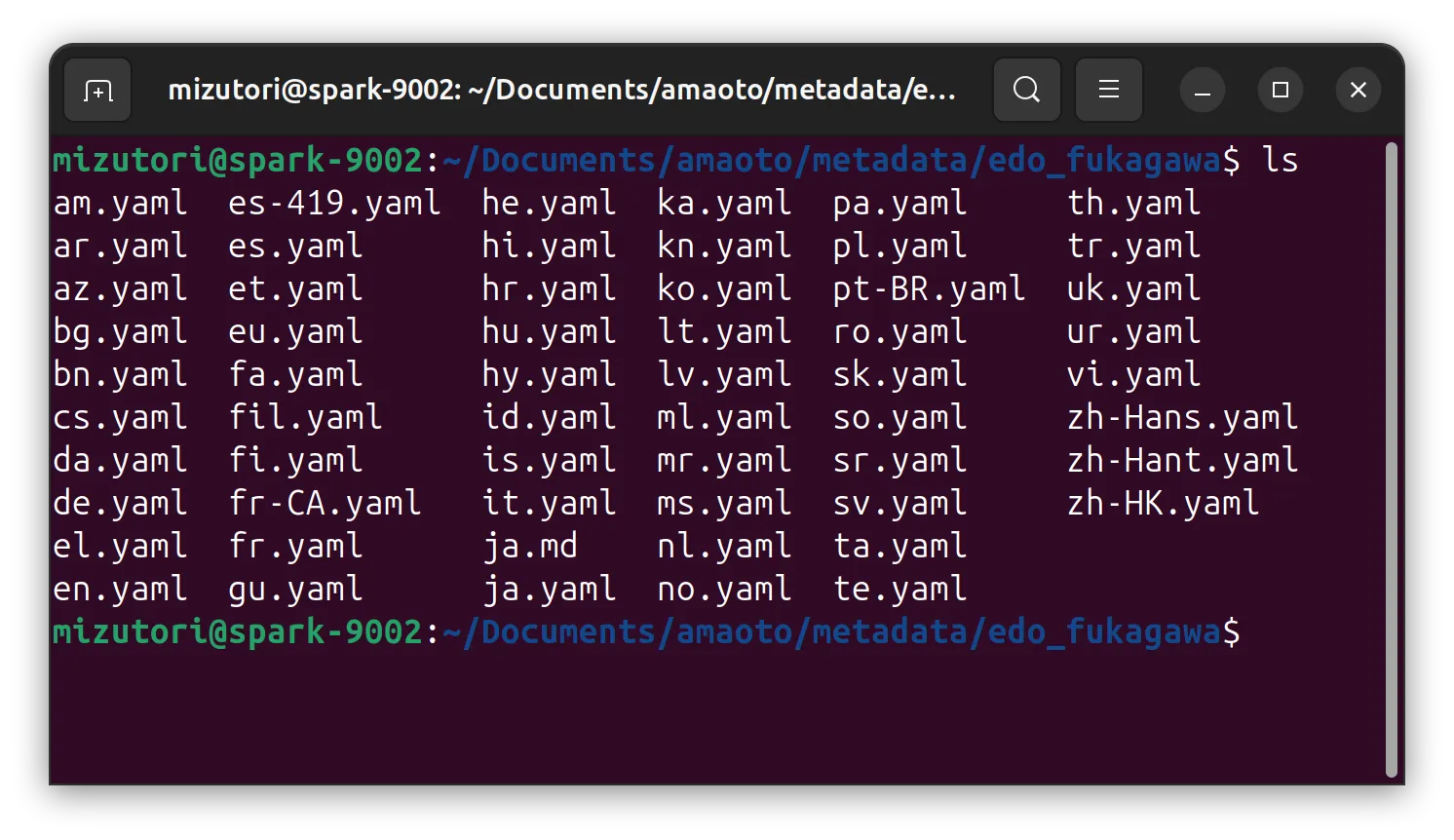
And so the first video was published carrying metadata in 56 languages. am (Amharic), az (Azerbaijani), bg (Bulgarian), bn (Bengali)… a long row of YAML files in alphabetical order. A human writes the Japanese source, and the machine generates the other 56 files. Generating the descriptions and titles across 56 languages meant the API script ran for more than 10 minutes for every single video. Still, I watched the terminal and waited, thinking that if it meant reaching an audience across the globe, it was a tiny price to pay.
Mostly Japan, and a Few from Korea
After three months of operation, the reality was stark. Almost all views came from Japan, followed by a small share from Korea. Reach from the other 54 language regions was virtually zero.
Why was a video theoretically open to the entire world only being watched in Japan? I asked our American intern at the office to try searching for the channel on YouTube. Typing “歴史の雨音” into the search bar naturally returned nothing. Searching in English for “Old Japan Rain” did not surface it either. It was only after typing the exact account handle, “@OldJapanRain,” that the channel finally appeared at the very bottom.
In other words, the discovery path itself did not exist.
Localization helps refine the experience once someone has found you, but it does not create the discovery itself. As long as the platform’s recommendation algorithms do not serve a nascent channel to overseas viewers, the 56 descriptions generated over 10 minutes each time never had a chance to be read by anyone.
Long-form videos hovered around 200 views at best, and barely 10 at the low end. Confronted with these numbers and the language breakdown, in June I reduced the translation targets from 56 languages to 14. Scaling down to 14 languages immediately eliminated the 10-minute bottleneck in metadata generation, smoothing out the entire pipeline.
The lesson was simple: when trying something new, start small. It would have been far wiser to test the waters with just a handful of languages first. Instead, I let my curiosity get the better of me — translating into languages I had never even encountered, like Amharic — and ended up wasting both time and tokens.
The Traps of Audio Language Code “zxx”
In the course of setting up multilingual support, YouTube’s platform quirks threw us for a loop — specifically around the “audio language” setting.
Since rain videos contain no dialogue, the ISO-standard code for “no linguistic content” is zxx. Selecting “Not applicable” in YouTube Studio does indeed set the value to zxx internally.
However, when updating metadata via the YouTube Data API, sending zxx throws an HTTP 400 error (invalidVideoMetadata). Even though it is a valid setting in the UI, the API refuses to accept it. To work around this, I simply omitted the field from the upload script and relied on Studio’s default settings.
There was also a brief back-and-forth with Claude Code on this. It suggested that leaving the audio language as “Not applicable” might make it hard for YouTube to determine the original language, potentially hurting overseas distribution, and recommended setting it to ja. I gave it a try, but overseas traffic didn’t budge at all. Eventually, we agreed that we should just revert to zxx, and now I manually set it back in Studio.
Platform quirks and AI advice alike: nothing is certain until you actually run it and see what happens.
Trying Out Vertical Shorts
Alongside the multilingual rollout, I decided to revisit the video format itself.
Long-form rain videos are mostly used as ambient background audio, where sound takes center stage and visuals are secondary. But I wanted people to actually see the historical scenes generated by AI. Moreover, long-form videos from an unknown, brand-new channel rarely get recommended or discovered on YouTube. Shorts, by contrast, are actively served to random new viewers by the platform’s recommendation engine.
So I built a dedicated pipeline to output the same historical scenes in a 9:16 vertical composition.
For long-form videos, assembling 15-second clips into a 30-minute video with ffmpeg required crossfades, stabilization, and looping audio, sometimes taking hours of rendering. For Shorts, you simply combine a 15-second clip with rain audio. Because the YouTube app loops Shorts automatically, not even fade-ins or fade-outs are needed.
With the workflow drastically simplified, I posted the first video — and it immediately cleared 1,000 views.
Compared to long-form videos that got anywhere from a dozen to at most 200 views, this was literally an order of magnitude higher. While I couldn’t help wondering what all the hours spent rendering long videos and translating 56 languages were for, the discovery power of Shorts for a new channel was undeniable.
From that point, I shifted the strategy to focus primarily on Shorts at high frequency, producing long-form videos only occasionally. This evolved into a system that can generate a draft video in about 12 minutes.
Here is the very first Short that was published:
Unexpected Results from the Cat Parameter
As we continued operating Shorts, another surprise emerged.
In late July, on a whim, I added a cat parameter to the pipeline to place a cat into a scene. As it turned out, videos featuring cats performed noticeably better than the others.
To measure the effect, I increased the proportion of Shorts with cats from 16% to 50%. A 50/50 split would make it easy to compare the numbers and see how much difference a cat really makes.

What I Learned from the Experiments
This series of trials gave me three key takeaways.
First, hypotheses on platforms can’t be validated until you actually ship. Multilingual translation, switching to Shorts, adding cats — no amount of whiteboard discussion gave us the answer. We only understood the reality after running the channel for months and looking at real viewing data.
Second, if the cost of testing a new idea is low, experiment freely — but decide whether to pull back based calmly on data. I tried 56 languages because the marginal cost was close to zero, and scaled down to 14 the moment the numbers showed it wasn’t working.
Third, “getting discovered” and “the experience after discovery” are two separate problems. Multilingual metadata improves the experience after someone finds your content, but it doesn’t create discovery out of thin air. For a new, unknown account to get discovered, choosing a high-reach format like Shorts was necessary.
If you are interested in data-driven hypothesis testing or designing automated pipelines with AI agents, feel free to get in touch.