
Letting It Rain on Scenes from History
I once heard a story from my grandfather about a ball of fire appearing along the river at dusk. When generative AI made video possible, I wanted to capture that landscape, but crafting a narrative was more than I could handle. Stripping away characters and story, what I arrived at was simply letting it rain on scenes from history.
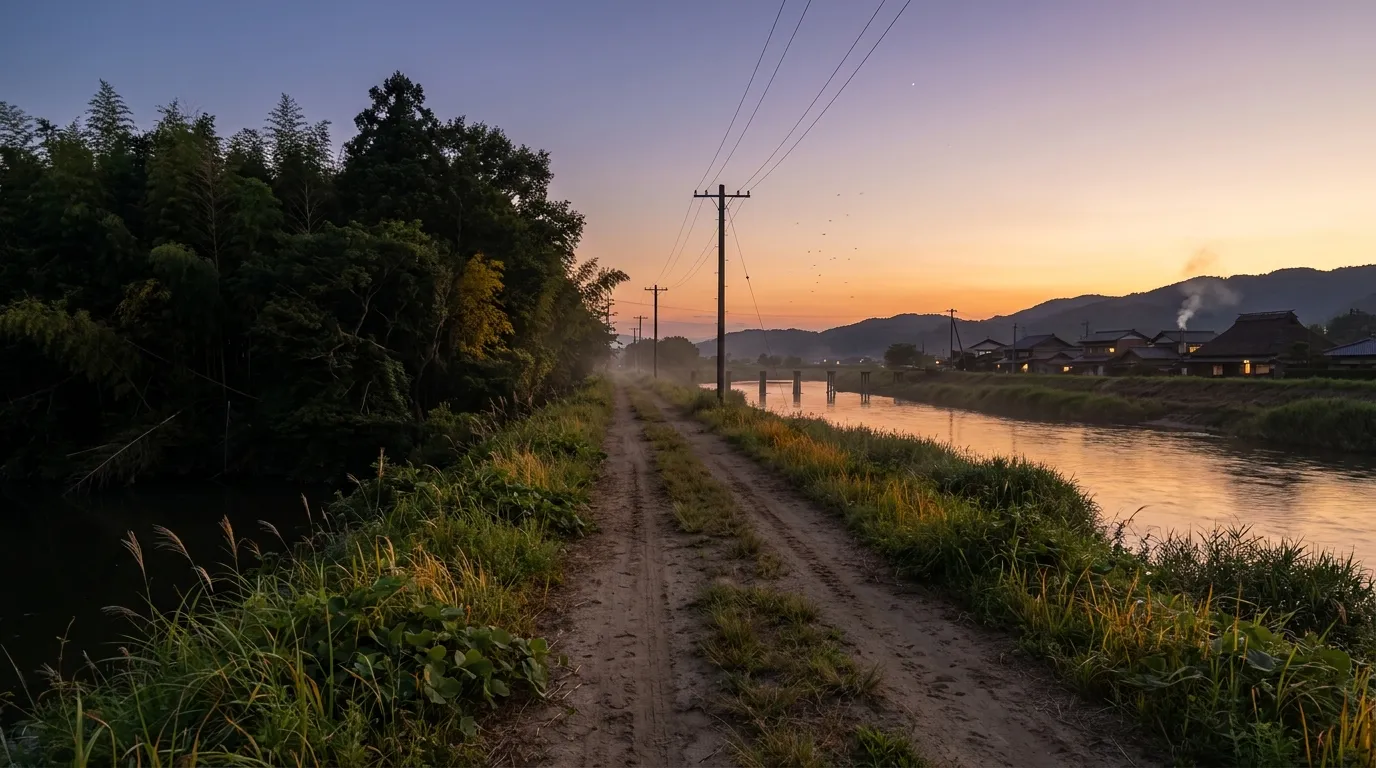
There is a story I heard from my grandfather when I was small. At dusk, a strange ball of fire appears near the bamboo grove along the river. It was only as an adult, from a book on folklore studies, that I learned this was what folklore calls kitsunebi, or foxfire, and that similar legends exist all across Japan. My grandfather was born in the Taishō era, and he told it not as a ghost story, but as one of the things that simply happened in the Japan of his youth.
The landscape my grandfather saw — the bamboo grove by the river at dusk where the ball of fire was said to dwell, the dirt paths and rice fields that once lay before it — has almost entirely disappeared today. Somewhere in me was a quiet desire to preserve, in some visual form, those fading scenes of old Japan.
Foxfire Was More Than I Could Handle
When generative AI made video creation accessible, the very first thing that came to mind was recreating that old story my grandfather told.
If it were just a matter of placing a ball of fire over a bamboo grove by the river, it might not have been much harder than the rain scenes I make today. But rather than ending with a single one-off video, I wanted to build a lasting channel by turning other Japanese folk legends into a series — stories my grandfather had told me about tanuki tricking villagers, or tales of the fox’s wedding (kitsune no yomeiri).
Yet the moment you try to tell a story, the hurdles multiply. Animals like foxes and tanuki, human characters, dialogue, dramatic pacing, and camera angles. When I tested ChatGPT to generate a fox character, it came back looking like a flashy cartoon sticker character from an 80s collectible sticker pack. I remember thinking, “This is going to be a much longer journey than I thought…” (unfortunately, I didn’t save that image).
Was there a simpler kind of video that I could actually make? It didn’t need people. It didn’t need a plot. Just something that could convey the atmosphere of the era,,
What I arrived at was simply letting it rain on scenes from history.
Rain That Turns Landscape into Sound
Rain fell in the past just as it falls today. The rain beating against the eaves of an Edo-period tenement, the rain quietly soaking a Heian temple garden, and the rain pattering against the roof of a Meiji-era train station are all the same rain, yet each must have sounded entirely distinct.
Whether striking tile, thatch, paving stones, or bare earth, the sound of rain translates the texture of historic architecture and ground into audio.
By layering the rain sounds that people of those eras might have heard over historical visuals, perhaps we can touch a stillness and presence that textbooks and old photographs could never quite convey. I simply wanted to see and hear those scenes myself — scenes that feel strangely familiar, yet have never quite been seen before.
That is how the channel Sounds of Rain in Old Japan came to be. In an Edo tenement, at an ancient temple, in a Meiji station — rain simply falls, quietly. That is all there is to the videos I publish.
The Rule of Doing Nothing Extra
When setting up the channel, I established a few clear rules. No narration. No burned-in subtitles. Keep the viewpoint fixed with minimal movement. And state plainly that the visuals are recreated images generated by AI.
YouTube has countless rain sound and ambient videos, but rather than comparing with others, I focused strictly on one combination: “historic Japanese landscapes × rain sounds.” Without adding artificial drama or effects, the videos are designed simply for watching the rain fall in silence.
Rooted in a Grandfather’s Memory
Today, production of this channel is run almost entirely by an AI agent pipeline. The engineering trials — the struggle with local LLMs and the night API credits melted away — are detailed in another article.
Yet the origin of this project was never a technical experiment. It began with the memory of my grandfather’s foxfire tale from childhood. Wondering what sounds people listened to as they lived among evening embankments and bamboo groves — that simple curiosity remains the foundation of everything I make here.