Tokyo to Saigon — A CEO Takes Vietnamese Lessons from a Middle Schooler
How I went looking for a Vietnamese teacher after opening a company in Ho Chi Minh City, and ended up learning from someone I never expected. Wrestling with six tones, and discovering — through Sino-Vietnamese — that Vietnamese is a distant relative of Japanese.
One year after opening a company in Ho Chi Minh City, I was starting to feel a real, growing panic that I still couldn’t speak any Vietnamese at all.
I’d actually started studying on my own well before that. I wasn’t sure I could keep it up, so I began quietly, without telling anyone. Fifteen minutes before bed each night, I’d simply read through a Vietnamese book. Four months of that, and I felt no progress whatsoever. I wasn’t seriously memorizing the words either, so at best I could look at one and think, “ah, right, that meant such-and-such.” Put bluntly, I had no sense that I could speak at all.
There was really no way around it: I had to find a teacher and take lessons.
No teacher to be found
Except finding one was surprisingly hard.
The biggest problem was pronunciation. Hanoi and Ho Chi Minh City apparently pronounce Vietnamese quite differently, and most Vietnamese teachers are from Hanoi. Since Hanoi is the capital, its pronunciation is presumably the standard. But in my case, the company is in Ho Chi Minh City — my business trips go there, and almost everyone I talk to is from the south. By far the more practical choice is the southern pronunciation.
One more thing made me hesitate. A Japanese woman who’d moved to Ho Chi Minh City was studying with a popular Hanoi teacher who even runs a YouTube channel — but three months in, she was still doing basic pronunciation drills and hadn’t been allowed to move past them. Three months of nothing but pronunciation. I don’t think I could stand it.
I’ve always been of the school that pronunciation is something that follows later. The Chinese I taught myself during my previous job, when I flew to Beijing every month, came the same way: I largely ignored the four tones and forced myself to speak, and it got corrected little by little along the way. First I want to get to where I can speak some phrases. Perfecting the tones can wait.
A CEO learns from a middle schooler
After a lot of thought, what I landed on was: have my own staff teach me. Every one of them is from the south or the center of the country, so their pronunciation is unmistakably southern. They aren’t language teachers, so they’d have no rigid method, and I could ask them to go in whatever order I wanted to learn. My Vietnamese is at the level of a first-term first-year junior high student anyway, so there’s no tricky grammar to worry about yet.
Two of my staff always listened to my pronunciation and nodded or corrected me. I sent a message on Slack to the older of the two, Kei. Would he do it? Would he turn me down? I waited nervously, and the reply that came a day later was not what I expected.
How about my son teaches you?
His son? He went on: my son is better at English than I am, and he’s studying Japanese, so I think he can teach you better than I could. Kei’s son was the boy who’d sat next to me at a staff member’s wedding recently — still around junior high age. Can he really teach me, I wondered, quite anxious about it, but figured I could always stop if it didn’t work, and asked him to give it a try.
And so, one year after founding the company, I began taking Vietnamese lessons from a Vietnamese middle schooler.
Six tones
The lessons run every Sunday at 8:30 in the evening. I’d assumed we’d use Zoom, but at their request we went with Discord — a tool I’d never touched, since I don’t play games. When I nervously opened it up, there on the other side of the screen were Kei and his son, Ken (not his real name).
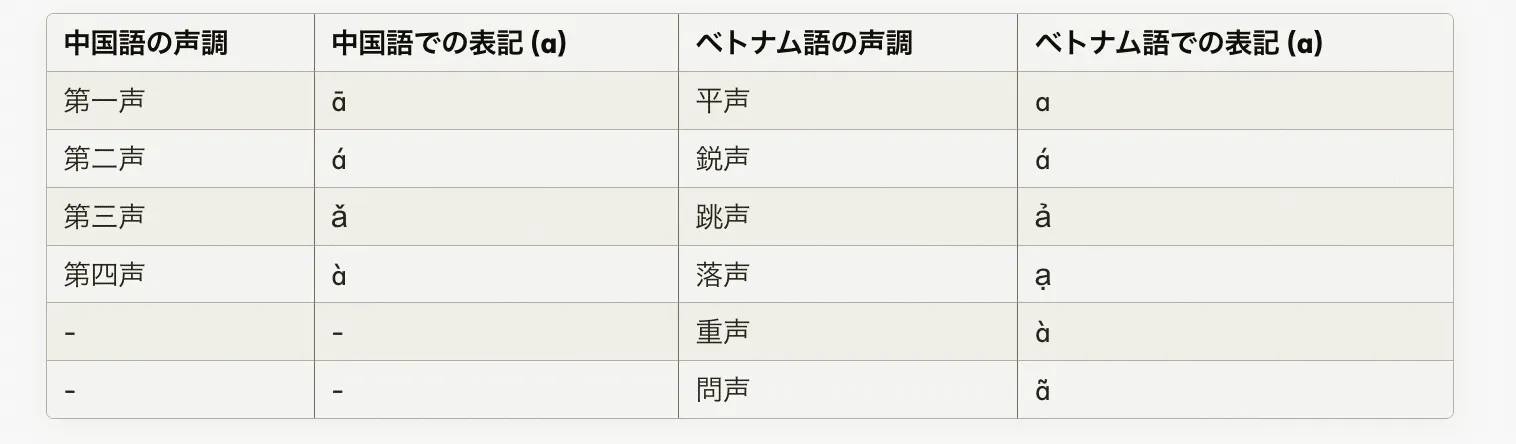
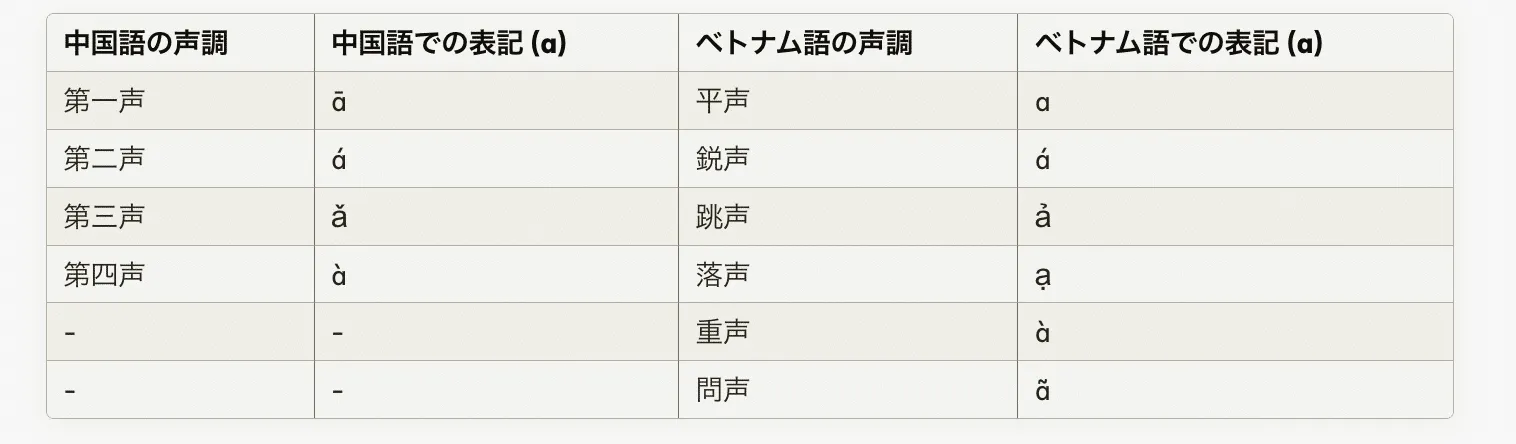
We started with tones. Vietnamese has, terrifyingly, six of them. Anyone who has studied Chinese knows it has four tones; Vietnamese has a full six.
a, á, à, ả, ã, ạ
Having dabbled in Chinese, I felt a little confident here. The rising á must be the same as Chinese’s second tone, I thought, and the falling à the same as the fourth. And I had my “secret technique,” discovered over countless corrections in Chinese: for a rising tone, focus on “lowering the start”; for a falling tone, focus on “raising the start.” That’s what makes them work.
“Time to unleash the secret technique,” I thought, and confidently produced an “a↓—↑.” Instantly, Ken corrected me. I tried again — “No.” Listening closely, his sound rose even further than in Chinese. I forced it higher still, and finally got his OK.
The à went the same way. My technique’s “raise it first” simply wasn’t to his liking. Looking into it afterward, I learned that Vietnamese’s à (apparently called the “heavy” tone) doesn’t correspond to Chinese’s fourth tone at all — the fourth tone is actually closer to the ạ that comes last. No wonder Ken flagged it as off within a second.
On that ạ, I suddenly remembered the Chinese word for “to play,” 玩 (Wán). It’s a rising tone, yet in real speech the “a” softly fades away partway through. That “softly fading” quality was the closest thing to ạ. When I kept 玩 in mind and said bạn (friend), I could swear the crease in Ken’s brow eased a little.
Even with a CD, there’s no way I could have learned this on my own. My mistaken “secret technique,” too, I’d never have noticed in a lifetime without someone correcting it. And yet, without my experience of the four tones in Chinese, I wouldn’t have spotted even the faint foothold in that wall of six tones.
Sino-Vietnamese as a foothold
What showed me that foothold far more clearly was Sino-Vietnamese — kan-etsu-go, the Chinese-derived layer of Vietnamese.
It began when I noticed that Mỹ, meaning America, is pronounced the same as the 美 in the Chinese word for America, 美国. Come to think of it, Hector had once told me that much of Vietnamese comes from Chinese. My textbook, too, introduced the Sino-Vietnamese “主日” (Sunday) to explain the word chủ nhật. Vietnamese written in kanji — if there were a book collecting these, I could surely build myself a table mapping kanji to Vietnamese.
I found “The Sino-Vietnamese Handbook” on Amazon, and opening it was one surprise after another. What I’d taken for random strings of the alphabet turned out to be the readings of the very kanji we use, spelled out in letters.
Take động, meaning 動 (move): động vật is “animal” (動物), hành động is “action” (行動). That “dong” is the same as in Mandarin. On the other hand, ngoại means 外 (outside): ngoại lai is “foreign/imported” (外来), pronounced roughly “ngai lai” — which sounds far more like the Japanese “gairai.” Mandarin’s 外 is “wài,” so here Vietnamese and Japanese are the closer pair. Japan, China, and Vietnam, all connected by the same words. With each page I turned, I found myself drifting into the romance of antiquity.
Back when I studied Spanish, I felt that the harder the word, the more it resembled its English spelling and the easier it was to remember — because harder words have drifted less from their Latin source. Vietnamese must be the same: the harder the word, the closer it gets to the Chinese pronunciation, and my knowledge of kanji and Mandarin should start paying off from there.
So the lessons with Ken, too, switched partway to using this Sino-Vietnamese handbook. 学 (học), 力 (lực), 望む (vọng) — for each Sino-Vietnamese character, there are four pages of example sentences, which I read aloud over and over while Ken corrects me over and over. The book covers 103 of these characters, and I’ve barely finished a handful. Even so, lately I can suddenly blurt out broken Vietnamese in a meeting. Everyone’s so surprised that it’s become addictive.
I’m well aware that a man who still can’t reliably count from one to ten is counting his chickens on a grand scale. But for a language whose roots overlap this much with my own, I want to master it no matter what. Vietnam and Japan, so far apart, yet sharing this much in their words. It leaves me with the funny feeling that — hey, we’re brothers, aren’t we.
Hang in there, Ken.