
The Day I Wrote "Akira Kurosawa" into a System Prompt
When I gave the system prompt for image generation the persona of a film director, the visual quality changed substantially. From the Doraemon demo I saw at a GDG (Google Developer Group) workshop, to grounding in NotebookLM, to the actual before-and-after images. The only thing I hold back is the full text of the prompt; the method, and what I learned from checking four months of viewing data later, are written up in detail.

The footage on the YouTube channel Sounds of Rain in Old Japan is generated with AI (the story of the channel as a whole is here). This article shares a key turning point that significantly improved image quality: using director personas in system prompts.
It Started with a Doraemon Demo
A few videos into the channel, while I was still feeling my way through production, I attended a Google AI Studio and Gemini workshop hosted by GDG Tokyo. During a break in the second half, the instructor demonstrated giving Gemini’s system prompt the persona of Doraemon. The responses instantly adopted Doraemon’s signature tone, prompting laughter across the room.
While laughing, an idea clicked.
The name Akira Kurosawa came to mind.
If a character persona could shift a model’s tone of voice, giving an image-generation prompt the persona of a film director might fundamentally reshape how the visual scene was constructed.
Grounding with NotebookLM Before Prompt Writing
Simply inserting a phrase like “in the style of Akira Kurosawa” might have produced some effect. Instead, I first gathered materials on Kurosawa’s filming techniques inside NotebookLM to establish grounding, then generated the system prompt on top of that material. Specific cinematography techniques — composition, the treatment of weather, high-contrast chiaroscuro lighting — were articulated into words and embedded into the prompt, rather than relying on a vague stylistic label.
Grounding in NotebookLM before writing prompts served as the backbone of our early production flow. We researched historical context in NotebookLM, generated image prompts, created stills in Nano Banana Pro, and returned to NotebookLM to draft video motion prompts. Prompts generated from grounded source material consistently outperform prompts written from scratch.
Night in an Edo Pleasure Quarter
Before attending the workshop, I had generated a night scene set in an Edo pleasure quarter using a standard prompt. After returning home, I regenerated the same scene using the Kurosawa-grounded prompt.
The difference in visual gravity was striking. The way light fell, the depth of the shadows, and the quiet tension of the frame departed completely from the generic, overly polished aesthetic common in generative images.
Here is the direct comparison:
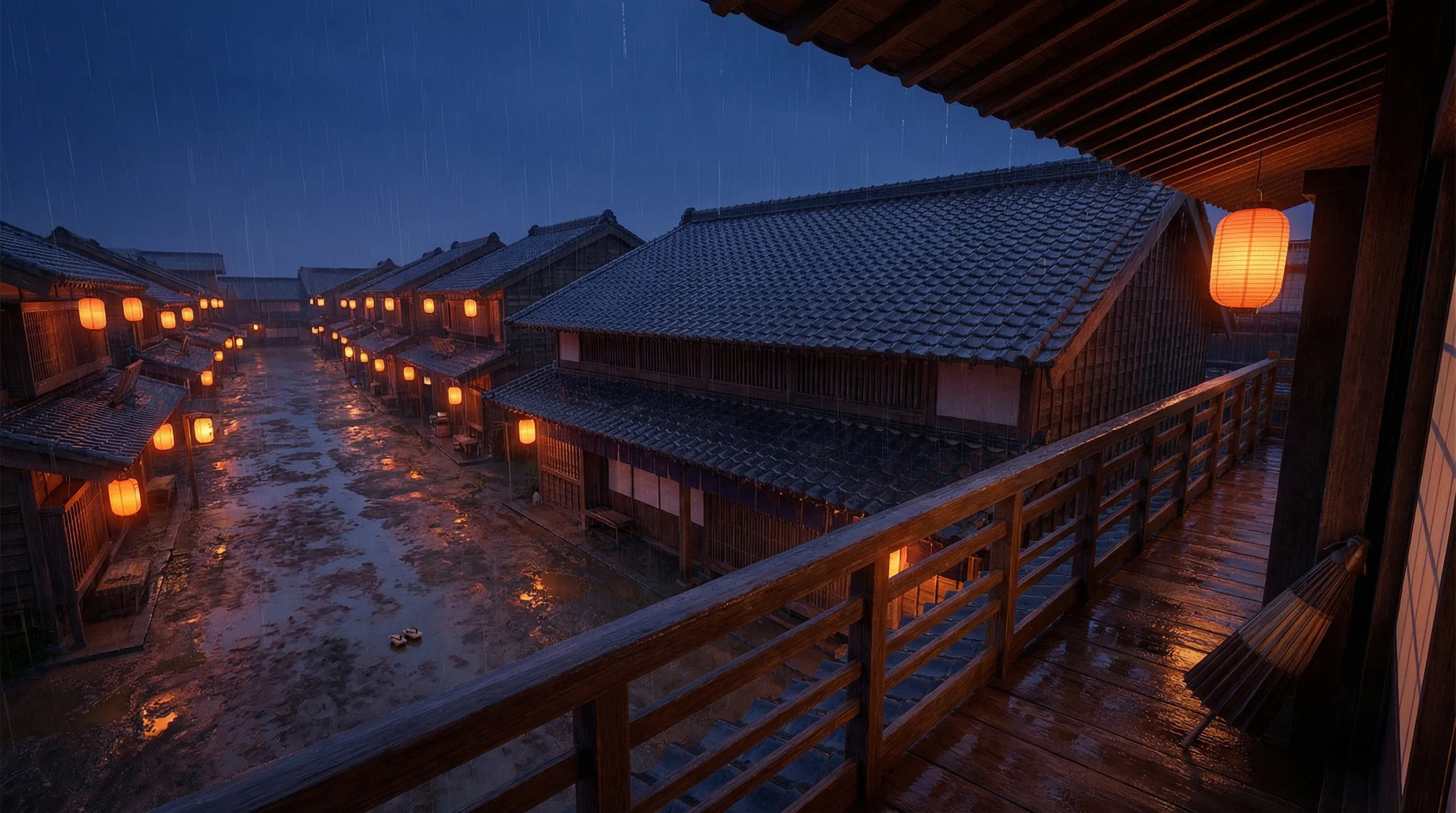
Before: clean, orderly, evenly lit lanterns. A pleasant AI-generated image, but lacking depth.
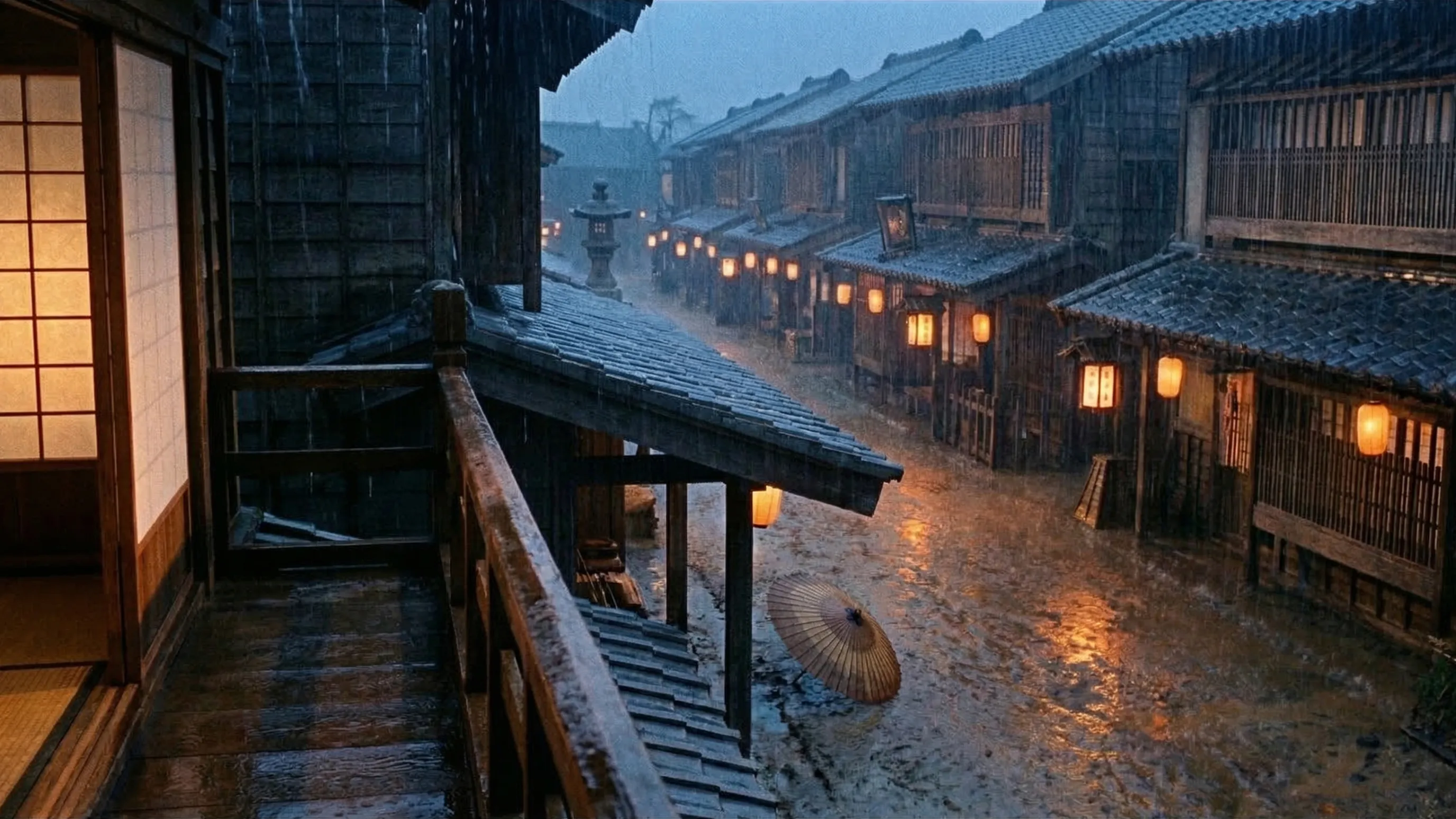
After: the same scene description, but the street turns muddy, reflecting dull light beneath heavier rain. An abandoned umbrella rests against a stone lantern. The camera shifts to an off-center angle peeking from under eaves, and deep shadows dominate the composition.
The Director Became a Production Parameter
This technique was eventually integrated as a formal configuration parameter in our pipeline:
scene_id:   edo_nagaya
era:        Edo
place:      tenement row
...
director:   kinoshita
We defined two distinct director styles: kurosawa for dramatic contrast, tense framing, and heavier weather; and kinoshita (modeled after Keisuke Kinoshita) for lyrical, softer, and more pictorial warmth. Each scene was assigned one of the two based on mood.
System prompts thus evolved from mere tone adjustments into practical switches within production automation.
Comparing Performance Across Directors Four Months Later
By August, with several months of analytics data across published videos, two clear patterns emerged:
First, on average, videos produced under the kinoshita style outperformed kurosawa in viewer retention and watch time, though kurosawa occasionally yielded exceptional outlier hits. We settled on roughly a 2:1 ratio favoring kinoshita. A stylistic parameter introduced in April had evolved by August into a tool for data-driven creative balancing.
Second, viewers often value aesthetic appeal over pure realism.
When building generative video pipelines, creators frequently prioritize photorealism as the primary benchmark. For ambient channels dedicated to study and sleep, however, strict realism is not necessarily what provides comfort.
Viewers sought an idealized, evocative vision of historical Japan rather than raw fidelity. The data indicated that our production balance needed to lean toward visual serenity.
Injecting a director’s persona into prompts worked because it provided an implicit aesthetic framework — a definition of what makes a frame compelling. While technical parameters can define resolution or camera angles, artistic balance is much harder to specify directly. Personas bridged that gap effectively.
Grounding concepts in source materials first, then shaping tone through well-defined personas, is a technique with applications well beyond image generation. In Placing Human Craft Inside Full Automation, we applied a similar philosophy to curating our audio library.
If you are exploring prompt engineering, AI agent architectures, or generative media workflows, feel free to get in touch.