Tokyo to Saigon — Building a Company Across the Sea
Registration, an investment license, a business license, accounting, labor, and hunting for an office. A hands-on record of the unglamorous, grinding reality of actually standing up a company in Vietnam.

Deciding to start a company takes a moment. Actually building one across the sea turned out to be an entirely different thing.
After I decided to launch Goldrush Studio in Ho Chi Minh City, I came face to face with a mountain of unglamorous, grinding procedure — registration, an investment license, a business license, an office lease, monthly closings, labor. This article is a hands-on record of working through that process. If you’re about to set up a company in Vietnam, it will probably be of some use.
First, I consulted an expert
In January 2023, I got on a Zoom call with Mr. S, who runs a consultancy for setting up companies in Vietnam.
I’d first met Mr. S back in the spring of 2019. I was staying in Saigon for a week, researching the possibility of one day founding a company in Vietnam, and on the day before my last, feeling anxious that I “hadn’t done anything that led to a concrete next step,” I Googled for a Japanese person who could help with company registration — and found Mr. S. Back then I’d said “I’ll be in touch!” and gone home, but then the pandemic came, and four whole years slipped by.
When I reintroduced myself on the call — “I’m the one who visited you in 2019” — he graciously said, “I remember you.”
From there he walked me through the outline as I peppered him with questions: capital structure, board composition, the company name, the office lease, the registration process. One thing I found fascinating was the rule that in Ho Chi Minh City a company name can’t duplicate another within the city. If a company with the same name already exists, you can no longer register under that name. That’s why he told me to prepare three candidate names. Had I lined up a logo or a domain first, it would have been a disaster.
You can’t register a company without an office, and you can’t lease an office without a company
The registration steps are clearly more numerous than starting a company in Japan. I’d braced myself, but honestly, I was overwhelmed.
What vexed me most was that very first office lease. In Vietnam a contracted office is mandatory for the registration procedure — yet to sign that office lease as a corporation, you need a company to exist. Wait… how does that even work? Fine, lease it personally, then — except that expenses incurred before the company is registered apparently aren’t recognized as expenses. My head started to spin.
Then I remembered something. At a coworking space I’d toured a few days earlier, they’d told me you could register a company using one of their private rooms — a “service office.” When I asked Mr. S about it, he said, “Starting from a service office is one way to do it.” I immediately asked Hector to look into it.
Later, since Mr. S happened to be in Japan on business, I met him in person at his office, which doubles as a showroom in Omotesando. I went through the question list I’d prepared after the Zoom call, one item at a time — a barrage of questions, basically. The lease before registration, the monthly closing and accounting audit after it: my questions clustered around the places where the laws and business customs differ between Japan and Vietnam. My TODOs kept piling up until my head spun, but I was genuinely in awe of how fluently Mr. S could speak about the rules of founding a company in a foreign country.
We found an office
While I was still torn between the coworking room and a proper office, Hector — whom I’d asked to hunt for a place — sent over photos and videos of three candidates.
One of them was a room that looked wonderfully comfortable. Two square rooms connected together, with a balcony at the back. It was on the second floor, and beyond the balcony there were street trees, and right past them, the street itself. A French-style balcony and tropical street trees — having only ever known Ho Chi Minh City as a tourist, I can’t help being drawn to a place with those unmistakably Vietnamese touches. It was in District 1, in an area even I had some sense of, and the rent was far cheaper than I’d expected. Hector, too, thought this was the best of the three.
But not every property in Vietnam can be used for registration. Hector connected me with An, the agent at the real estate company. In Vietnam everyone uses an app called Zalo, which is like LINE. It turned out I could make an account with my Japanese phone number, and I dealt with An directly in a Zalo group. Mr. S’s lawyer phoned An’s number, and we confirmed the property could be used for registration.
The contract was in Vietnamese, so I checked the diff against the template I’d received earlier using the code-comparison tool I use every day — one of the few moments I’m glad to be a programmer. Vietnamese offices have security guards and set hours you can use the space, and since the hours in the contract differed from what I’d been told, I asked for a correction. The clause about not using anything with a fire risk included the microwave, so I negotiated to have that struck out.
I signed, pressed my stamp, scanned it, and sent it to An. Vietnam is a stamp society too. I paid the deposit the next day, and from that day I could move into the office. From the day we found the place — even after waiting a day for my passport to be reissued — the contract was concluded in five business days. That a foreigner could lease an office this fast. A country that’s growing really is different.
I got very familiar with accounting and labor
A company isn’t finished the moment you build it. If anything, that’s where it begins.
On a trip to Ho Chi Minh City, I visited accounting firms one after another. Mr. S had made me a to-do list of the accounting, tax, and labor tasks required right after founding, monthly, and quarterly — so my plan was to show it and ask which items each firm could support. I got around by Grab, Southeast Asia’s version of Uber. Every firm I visited was in a solid office building in a prime spot in District 1 or District 4, and I felt a kind of reverence for people doing business in a foreign land.
At one firm, the head of the company personally handled a knowledge-zero person like me who was suddenly trying to build such a tiny company. They didn’t just tell me what they could and couldn’t do; they carefully explained which parts the firm would handle and which I’d have to do myself, and the points to watch out for. Another firm kept a close, direct distance — they bluntly asked “why did you set up the capital structure that way?” and gave me candid advice I couldn’t have gotten anywhere else.
On the way to the third firm it was lunchtime, but there was no time to eat, so I had an old man at a roadside stall — piled high with green, tangerine-like fruit — make me a juice. Green skin, rich orange inside. Perfect for a tropical early afternoon, and it recharged me. Over two days I made the rounds of four firms, and my knowledge of the accounting, tax, and labor work my own company would have to do shot up all at once.

The investment license, and then the business license
For a foreigner to start a company in Vietnam, you need an investment license called an IRC. Only after obtaining that, then obtaining an ERC to actually run a business, is the registration finally complete.
One day, Mr. S let me know the IRC had come through, and for the moment I felt relieved. The PDF he sent was about five pages of Vietnamese, each page stamped by someone important. From there, preparation for the ERC would begin, taking a little under a month. The tricky part is that the company starts the instant the ERC is granted. If the ERC comes near month-end, the accounting close and the payroll date for that month arrive even though you don’t yet have a corporate bank account. So Mr. S times the application to have the ERC granted in the first half of the month.
Registering a company in Vietnam was far more complex than I’d imagined — something only an experienced person who knows the process inside out can pull off.
I once spoke at an event introducing Finland’s startup ecosystem, where someone from the embassy said Finland lets you register a company easily, entirely online. What an incredible country, I thought. I’d always found Japan’s registration process — which begins with making a stamp — a hassle, but compared to Vietnam, it was far, far simpler.
I received the original licenses
One morning, Hector and I walked to a hotel run by Mr. S’s company. Even within District 1, walking from the southern end to the center takes a while. We arrived five minutes late, and Ms. V, a director, and Mr. T, a lawyer, welcomed us in the spacious lobby.
I’d brought souvenirs from Japan — Kurumikko cookies from Kamakura and Inoda Coffee beans from Kyoto. “Bringing coffee as a souvenir for Vietnamese people — that takes guts, Mr. Mizutori,” Ms. V and Mr. T laughed. Vietnam is the birthplace of coffee. I’d bought it precisely because I wanted them to do a taste comparison. Mr. T made a face and laughed, “foreign coffee is weak.”
I sank into a plush chair, and Ms. V handed me the originals of the investment license and the business license. When I registered my company in Japan, they’d only tell me the expected completion date and I’d check the registry myself — so compared to that, this was a far more moving moment.
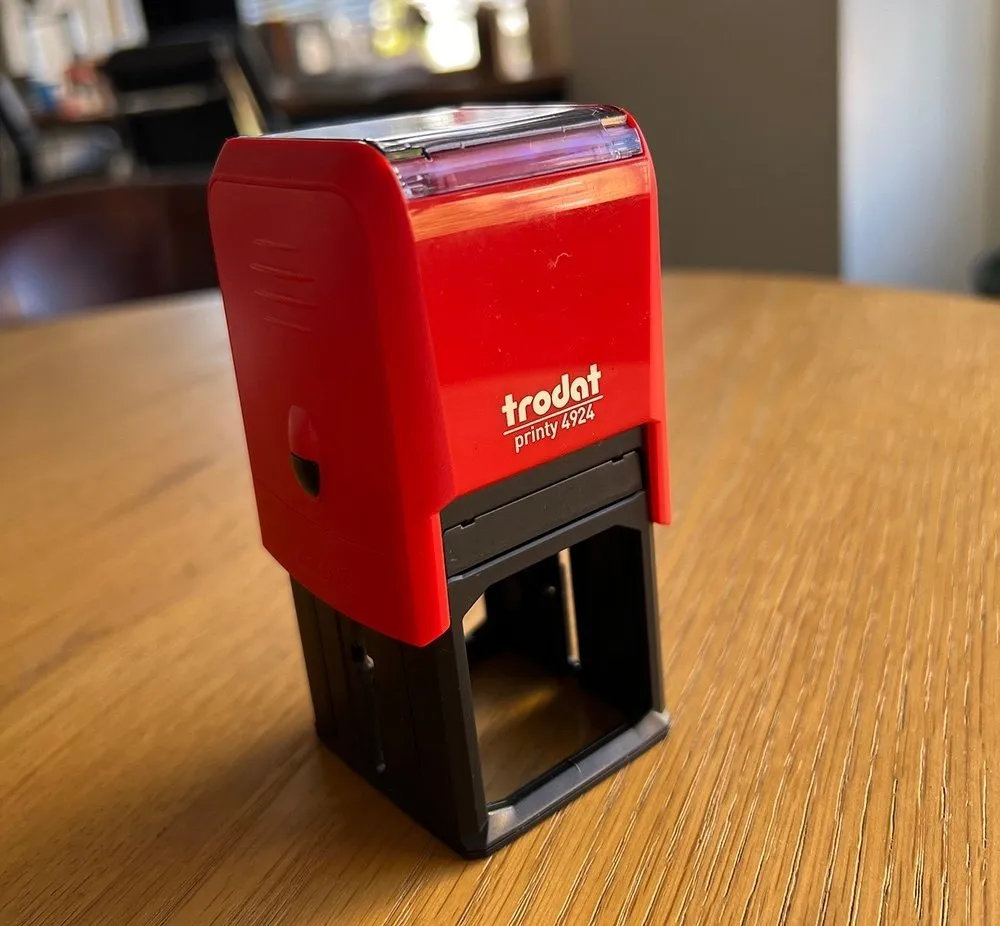
The company seal can’t be made without the business license. Here it’s the reverse of Japan. Because Ms. V had gone to have it made right after the license was issued, the seal was already ready. I knew Vietnamese seals have a large radius, so the day before my trip I’d bought the biggest ink pad at Sekaido — but what I was handed was a self-inking Shachihata type. A huge Shachihata-like sealing device in a modern plastic housing, no ink pad required. My Sekaido ink pads ended their service without ever getting used.
Across the sea, a company now stood. Looking back on the mountain of question lists and TODOs I’d stacked up before the registration was done, the truly hard work wasn’t starting — it was finishing this grinding procedure, one item at a time.