Tokyo to Saigon — Becoming One Team Across Two Countries
Members split across Tokyo and Ho Chi Minh City, on either side of the sea, slowly becoming one team. A silly weekly question, the spirit of mutual aid in a Saigon morning, a study group on audio technology. How a guy who dislikes recurring meetings found a way to build trust in the first year of a cross-border team.
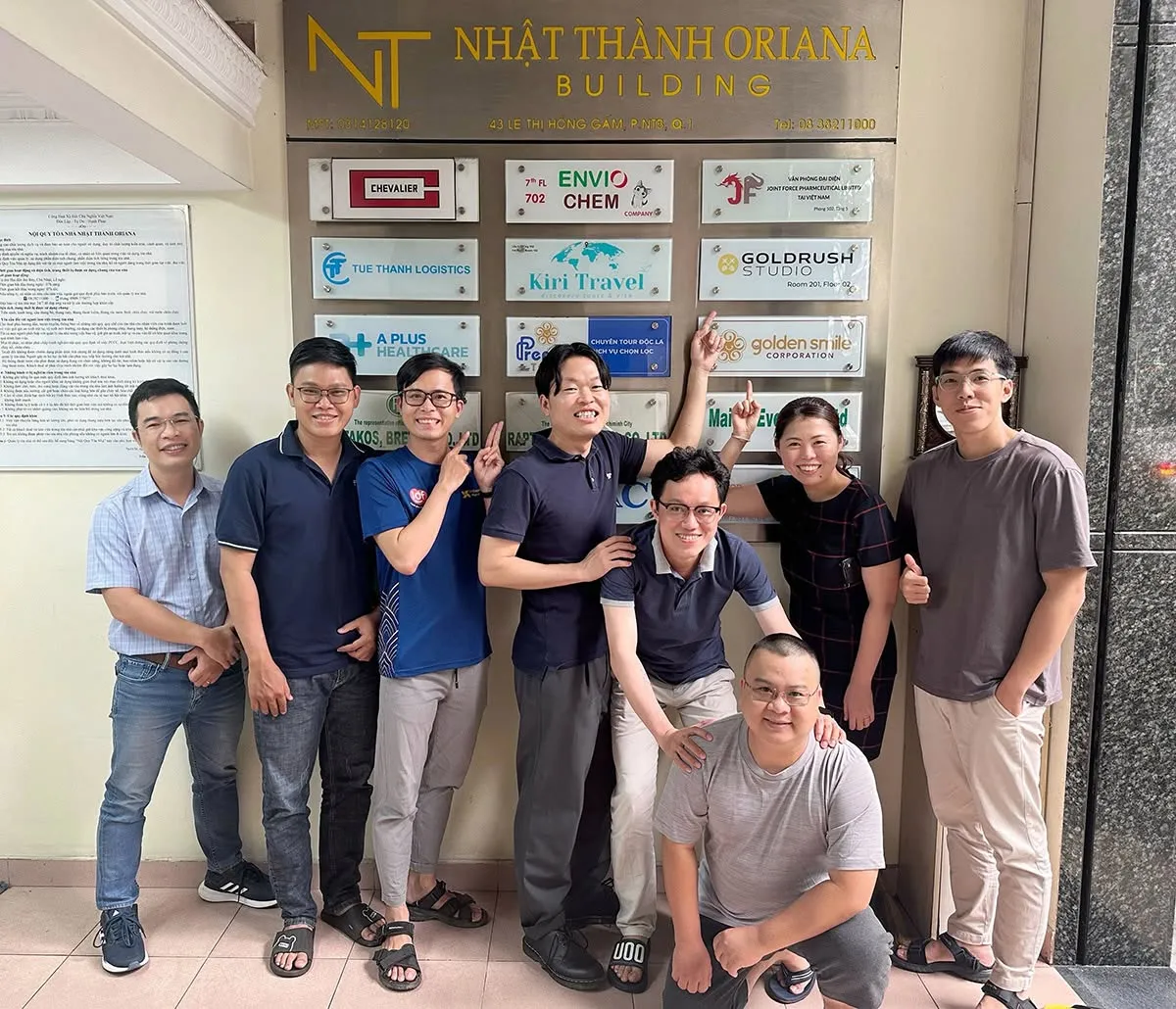
Our team is split across two countries: Tokyo and Ho Chi Minh City. Goldrush Computing in Tokyo, and Goldrush Studio, the subsidiary we set up in Ho Chi Minh City in July 2023. We build together, dividing the work across the sea. Once we got started, the hard part turned out not to be the technology — it was getting members in two countries to become one team.
A guy who dislikes recurring meetings
If I’m honest, I don’t like recurring meetings. I prefer to hold a meeting when a topic that needs one comes up, and focus on that topic. We manage tasks in GitHub Issues, and the day-to-day communication happens directly between members on Slack. So there aren’t really that many topics that need a fresh Zoom call.
Even so, I started a weekly standing meeting because of something a Vietnamese company president said, speaking at a seminar on entering the Vietnam market hosted by the Tokyo Metropolitan Government. “Every day, even for five or ten minutes, connect on Zoom and greet each other. That is what matters.” He repeated it over and over. Even with no agenda, there is meaning in simply seeing each other’s faces — I changed my mind.
The trouble is, when you connect a group over Zoom, the communication inevitably becomes a single line connecting two people — me in Tokyo and Hector, the leader on the Vietnam side — with each of our teams standing behind us. What I really wanted was to have casual, offhand chats with each member. That was the frustrating part.
Every week, someone thinks up a question
The first meeting ended with us greeting each other and randomly sharing our recent news. As expected, it wound down with Hector and me doing almost all the talking.
I was thinking this wasn’t good enough when L, a junior engineer at our company, made a suggestion: what if, each week, one person thought up a question, and we set aside time for everyone to answer it? It was a genuinely youthful idea, the kind I could never have come up with myself.
If you had to quit being a programmer or engineer, what job would you choose?
Not home and not work — where is the “third place” that matters to you?
Every week, an interesting question would come up. Hearing the answers, you’d catch a glimpse of a side of a member you hadn’t known. To the question “How do you spend your weekends?”, H’s answer was going to the sea and flying a drone. H, it turns out, has a pretty full life.
At first I was skeptical, thinking it was a childish idea, but maybe that childishness was exactly the point.
There was another unexpected byproduct. The Vietnam team’s English: their reading and writing are at a TOEIC 800-plus level, but the four members other than Hector and P struggle with listening and speaking. Yet as we kept holding the meetings, those four gradually got better at speaking. These are guys who study by reading the original O’Reilly books in English. They’d simply never had a chance to speak — their room to grow is infinite.
A Saigon morning and the spirit of mutual aid
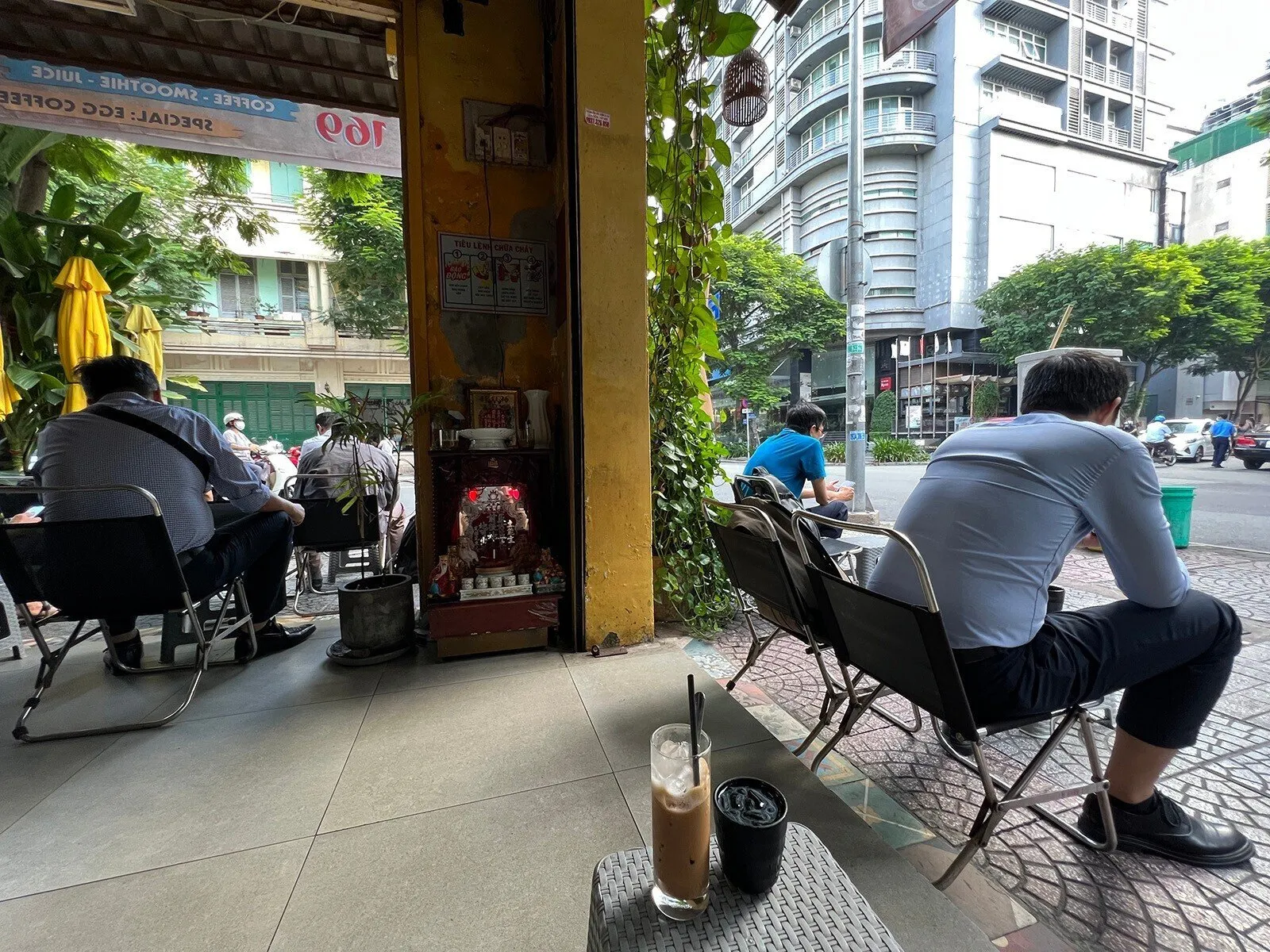
Whenever I’m in Ho Chi Minh City, I get absorbed in the morning scene. Coffee shops everywhere, men perched on low stools out front, drinking coffee and talking, or just gazing off at the street. One morning I did the same — I bought bread at a bakery that V, one of our members, had told me about, went into a nearby cafe, and made myself part of the Saigon morning over a coconut coffee.
Just then, a man selling what looked like lottery tickets came into the cafe. When I raised my hand a little to signal “no thanks,” he moved on to the other customers, one by one. Neither the waiter nor the woman who seemed to be the owner at the back paid him any mind. They were quietly allowing it.
In a Japanese cafe, someone who came in and started selling something else would be told off immediately. I felt a kind of tolerance still alive in Vietnamese society — a spirit of mutual aid. There is probably no social insurance system as developed as Japan’s, but this sort of safety net lives on among ordinary people. Postwar Japan, I imagine, must have had something like it too.
When the place you work in is different, the texture of daily life is different too. Taking in that difference, and all — that, I think, is what it means to become one team across two countries.
Learning audio, together
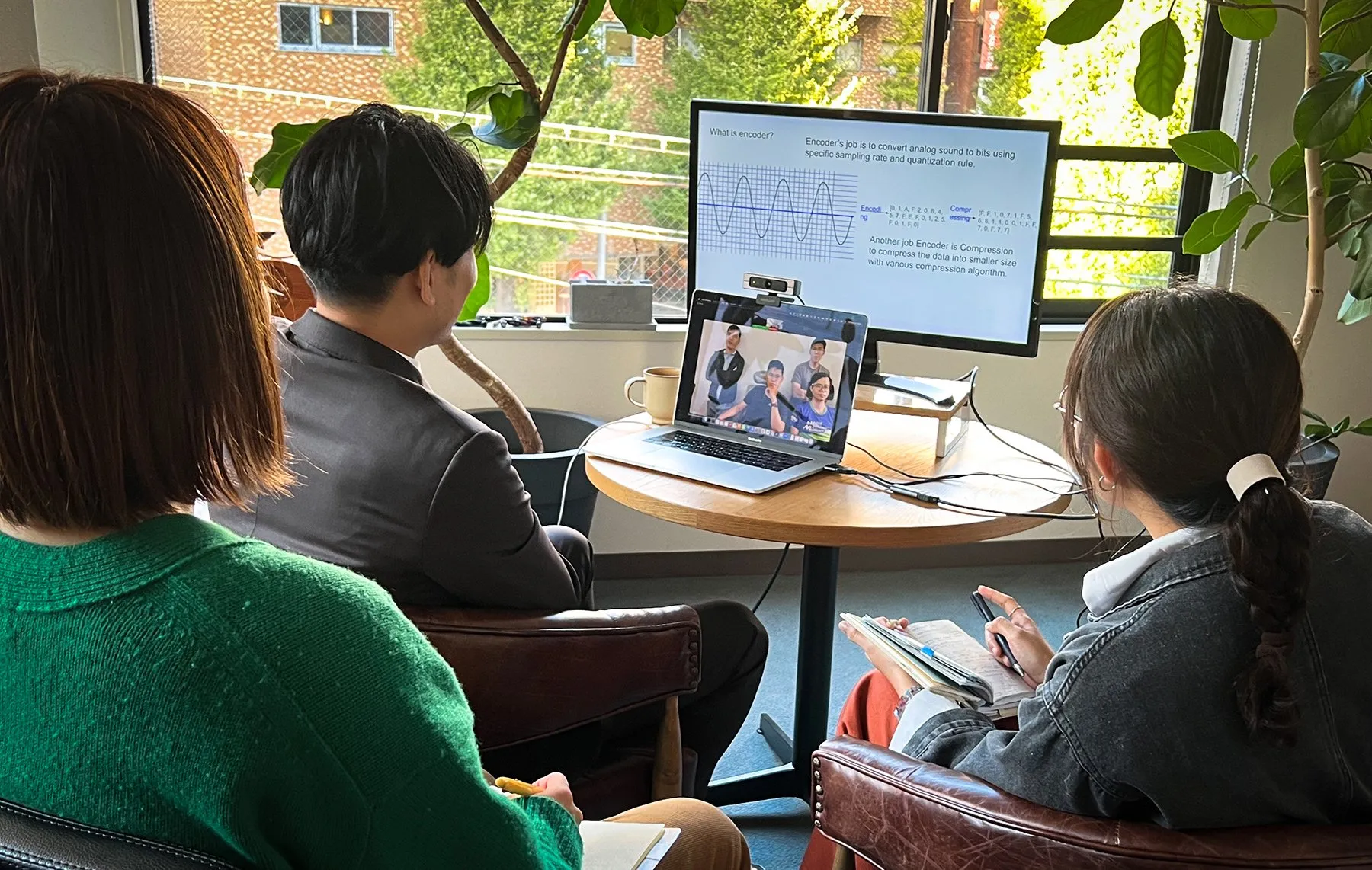
To grow as a team, we also held a study group.
Recently we had been working on a machine-learning-times-audio project. In the process, I discovered that the Vietnam team isn’t strong in audio technology. They can properly deploy an ML model, implement the API, and generate audio. But at the stage of evaluating what they’d generated, they lacked the technical knowledge of audio itself, and couldn’t evaluate it accurately.
Before I went independent, I worked at Sony Ericsson. Sony, as the name suggests, is a company of “sound” — famous for the Walkman, but it was also Sony, not so widely known, that created the CD standard. In an environment like that, even engineers who don’t specialize in acoustics carry a certain baseline of audio knowledge. So I’d been mistakenly assuming that was a given for any engineer. It hit me. This wasn’t the members’ fault — it was mine, for starting a project without providing the education they needed.
I rallied and, in about two hours, put together material to understand audio codecs and file formats from the ground up. Make it too rigorous and the barrier to understanding rises, so I kept it rough — the kind of thing that would just barely not anger a specialist, or, well, maybe anger them a little. Since we happened to have freshly generated audio data on hand, the study group became very real and grounded.
A software engineer is not someone whose job is complete just by being fluent in computers and programming. You have to keep widening your knowledge into the domain, the devices, and the data you’re working with. That’s the hard part — and the interesting part.
Looking back on the first year
For a while after the team was formed, we struggled with a lack of projects, but from there we somehow won four, and in 2023 we completed all four.
The first was an iOS/Android app built with Flutter; the Vietnam team handled the Flutter side, and the Tokyo team handled the native Swift and Kotlin parts. The second, a Ruby on Rails and React project, was led by the Vietnam team, with Rails being their strength. The third we did end to end, from design to infrastructure, in node.js and Vue.js. And in the fourth, a PoC using OpenAI, Tokyo handled the AI parts while Vietnam handled the front end and DevOps.
Looking back, our team had a tendency to overload the people strong in front end, while the people strong in back end and infrastructure often had time to spare. One reason was that each individual project was a little on the small side. With back end and infrastructure, the bigger the project, the more there is to do.
Between Goldrush Computing (Japan) and Goldrush Studio (Vietnam), we can design and build everything — UX/UI design, smartphone apps, web front end, back end, infrastructure and DevOps. Meeting a somewhat larger project where we can put that full capability to work: that, I feel strongly, is my mission for 2024.
A team split across two countries, slowly becoming one through a silly weekly question, a morning coffee, a study group on audio. That feeling of it happening may have been the greatest harvest of this whole year.